Monday, 3 March 2014

In a Cup of Tea


In a Cup of Tea


Fortune Cookie

Disobedience is the true foundation of liberty ~ Henry David Thoreau


"In a Cup of Tea";


Kobayashi's  Award-Winning film  won the Cannes Special Prize in the 1960s. This is the film Trailer: -


The tea story lies at the end of the film.


"In a Cup of Tea" is adapted from Lafcado Hearn's Kotto: Being Japanese Curios, with Sundry Cobwebs (1902).

A writer who is anticipating a visit from the publisher, keeps seeing faces in a cup of tea. He is writing a story about a samurai's squire who begins to see a face in his cup of tea. We only meet the writer at the story's end.


The film won the Palm D'or Special Jury Prize at Cannes in 1965.


For more on Japanese teas visit this excellent website:


The cup of spilled tea haunts the squire.


The squire sees the soul in his cup of tea. Eventually he drinks the tea with the image in it.


The soul about to be swallowed.


The meaning of the stories are left unexplained and is for the audience to determine. That the stories come from Japanese folk tales suggest a way to read such a story. All four stories are about the spirit world and the need to have a respect for the dead, the need to monitor personal behaviour and respect. 


If you visit this blog visit its twin GuerillaZ  the travel blog  at the end of this link:


Happy Tea Drinking!


Monday, 10 February 2014

Hoji-cha


Roasted Japanese Tea

ほうじ

Hoji-cha (Houjicha)


Fortune Cookie

使用你擁有的人才,為樹林會很沉默,如果沒有鳥唱,除了最好的

Use the talents you possess, for the woods would be very silent if no birds sang except the best.


In the UK we have a phenomenon known as Blue Monday. This day is designated as the result of a mathematical equation. An equation already rubbished by most critics. Still, in January, it feels right.

This year the day fell on January the sixth. Far too early in my view.


Blue Monday is supposed to be the most depressing day of the year based on:


  1. Levels of personal indebtedness after Christmas
  2. The appalling nature of the weather
  3. How soon our New Years Resolutions have failed
  4. Sundry other factors


When this day occurs it is timely to drink a fine, if not excellent cup of tea.  It wasn't fine tea I found but Hojicha is an excellent tea.


This shop is good for picking up tea without recourse to the Internet and attendant postage costs. I decided on 100g of genmaicha and a hojicha. More of the Hojicha later.


There is a good energy around Chinatown happily reminding me of my visit to China in the spring. 

Some of the hustle and the street food of Yunnan is here with some changes (mainly added sugar). 

Having said that I went Indonesian at the restaurant devouring an outstanding beef rendang with rice and greens. 


Right next to Oriental Delight is Chinatown's most famous bakery, The Golden Gate Bakery. 


Here they do sweet desserts as well as savoury buns. They do a good lotus bun and an excellent bun filled with red bean paste and covered in sesame seeds. My personal favourite is the BBQ pork bun (£1.30). A bun glazed with sugar is stuffed with fresh and sweet char sui pork. Best value food items in Chinatown. Definitely worth a pilgrimage to.


On Hoji-cha (Houjicha) ほうじ


Kensho, a book of Zen thoughts, contains a koan that tells us of the provision of a cup of tea, instead of testing and agitating the tongue in futile speech, bringing someone a cup of tea says something about giving - the most valuable act of a bodhisattva. Often speech adds nothing and just as often intends to take away.


If you like this blog visit its twin GuerillaZ the travel blog at the end of this link:


Hojicha is a Japanese bancha grade of green tea. Made from the lower shoots of the tea plant the reddish-brown leaves make it hard to believe it is a green tea but the colour comes from the slow roasting in a porcelain pot over charcoal. 


This roasting also gives the tea its unique woody aroma with the roasted and nutty overtones.


Bancha hojicha has an incredibly smooth flavour and very low levels of tannin.

For more on Japanese teas visit this excellent website:

My Japanese Green Tea


In Japan it is believed that the slow-roasting also reduces the caffeine content of the leaf making it good for post-prandial consumption and good for children and the elderly.


A deep red tea


Hojicha works well with these.


Happy Tea Drinking.


Wednesday, 22 January 2014

Nine Teas


9 Teas


Fortune Cookie

在溝通中最重要的是要聽聽是不是這樣說。

The most important thing in communication is to hear what isn't being said.


Welcome to readers from Finland and the United Arab Emirates


I thought of the happiness drinking tea has brought me lately and it surprised me.


At the shambolic surface of my desk I decided to do an inventory on the teas I had in my tea chest and cupboard.

This is what I found.

In the garage I have a good Sencha, a Genmaicha, three flowering tea balls and another tea I can't remember what. I drank all the Rose Congou and Chun Mee while I was travelling through Indochina last year.

I am just in the process of finishing a batch of Sencha Sakura, and a tiny 50g box of Happy Valley Darjeeling.


That leaves nine teas. Five are Chinese, two Vietnamese, one Japanese and one of indeterminate origin.


Taiwanese Oolong                        Gunpowder tea (Zheijiang province)      Earl Grey Blue Royal


Fujian oolong. I must be perverse because I can never entirely get along with oolong. Woody and smokey more than a little is too much for me. Two cups works fine.


Gunpowder tea from Zheijang

Deep and rich this is smooth and strident green tea using whole leaves.


If you like travel with your tea visit Singing Birds sister site GuerillaZ travel at:


Earl Grey Tea (black tea said to come from China with added oil from the bergamot green orange from Italy). Whether the present day leaves still come from China is moot. Think Kenya, Uganda, India.

The taste is sweet, subtle but the fragrance always fades after three or more weeks. Drink quickly.


Bac Thai (yellow tea)                              Hojicha                          Vietnamese Lotus Tea


                  Bac Thai from Thai Nguyen


It's a nice tea with a rich liquorice smell. The black leaves produce a lemon yellow tea. 


Bac Thai steeped. A rather beautiful thing. 


Hojicha (Japanese roasted tea)


A tea easy on the eye. spiky roasted tea which is rich and nutty. Wonderful on the nose but very mild on the palate. A tea to generate smiles. Made from low grade tea known as Bancha.


Lotus tea (tra sen) from Lamdong


A super tea with floral notes. A subtle tea that carries a bouquet that inspires happy feelings. The smoothest tea I have had in the last 12 months.


                 ? Mystery Tea ?           Yunnan Green Tea            Russian Caravan Tea                


Unknown Tea Leaves


Unknown tea steeped: the aroma is faintly of lemon with a malt undertone. It is a mild black tea. 

I have no idea what this tea is or even where I got it from. It may have been a gift from a year ago when someone bought me six teas.

One day I will discover what this tea is.


Yunnanese Black Tea

Mild and lightly smoky.


Russian Caravan Tea

Russian caravan tea is a blend of oolong, keemun and lapsang souchong.

This tea is not easily found. It is malty and a big favourite at the Cardews Tea Emporium in Oxford. I can see why. A comforting blend.


Happy Tea Drinking!


Wednesday, 8 January 2014

Tea @ the Covent Garden Hotel


Welcome to readers from Israel and Romania


Fine tea at the Covent Garden Hotel


Christmas Lights at Seven Dials


Fortune Cookie


Rivers need springs

Satodoru 斯需 main 彈簧


http://singingbirdsingingbird.blogspot.co.uk/


The opportunity came again to drink fine tea. It got me to thinking about the origins, places, 

people and processes behind a simple order for a pot of tea.


Fine tea complete with mince pie.

A second flush muscatel Darjeeling


Darjeeling is high up in the hills of West Bengal. These are essentially the mammoth hills just below the Himalayas.


Traditionally, Darjeeling teas are classified as a type of black tea. However, the

modern Darjeeling style employs a hard wither (35-40% remaining leaf weight

after withering), which in turn causes an incomplete oxidation for many of the best

teas of this designation, which technically makes them a form of oolong. They

certainly present as an Oolong in their light, golden colour. Many Darjeeling teas

also appear to be a blend of teas oxidised to levels of green, oolong, and black.

The first flush is harvested in mid-March spring following rains, and has a gentle,

very light colour, aroma, and mild astringency.

Between tea is harvested between the two "flush" periods.

Second flush is harvested in June and produces an amber, full bodied, Muscatel-

flavoured cup.

Monsoon or Rains tea is harvested in the monsoon (or rainy season) between

second flush and autumnal, is less withered, consequently more oxidised, and

usually sold at lower prices. It is rarely exported, and often used in masala chai.

Autumnal flush is harvested in the autumn after the rainy season, and has a

somewhat less delicate flavour, less spicy tones, but fuller body and darker


colour.


If you Like this blog visit its Twin  GuerillaZ at the end of this link:


Then again I could choose a silver needle white tip from the Fujian province of China.


Baihao Yinzhen  white silver needle is also known as White Hair Silver Needle, is a white tea produced in Fujian province in China. 


Amongst  white teas , this IS the most expensive and the most Variety Prized, as only 

top buds (leaf shoots) are used to produce the tea. Genuine Silver Needles are made 


fromcultivars of the  Da Bai  (Large White) tea tree Family. This tea HAS Fine Downy 


hairs which catch the light. It is commonly included among the China classic teas.


Choosing between the two teas very difficult. 


This is a beautiful hotel that serves ten fine teas and a range of herbal teas. All loose leaf of course.


And while you are in Covent Garden you could buy some fine cheese


Or high quality coffee


Happy tea drinking wherever you are

Cheerio for now


Tuesday, 17 December 2013

Sencha Sakura


Sencha Sakura


Welcome to readers from Finland and Liberia


Fortune Cookie


誰が、私は私の茶室でお茶を飲みながら午前とき、私は私が私の唇にボウルを持ち上げるのこの瞬間が永遠自体が時間と空間を超えていることで、その宇宙全体を飲み込むいことを否定するでしょうか?

Who would then deny that when I am sipping tea in my tearoom I am swallowing the whole universe with it and that this very moment of my lifting the bowl to my lips is eternity itself transcending time and space? ~ D.T. Suzuki


Sencha Sakura


Sakura is the ubiquitous flowering cherry tree planted in Japanese parks, along streets and within commons and yards. During late March through May, Sakura blooms across Japan. The Hanami festival celebrates the coming of the spring season and is the time to take a stroll and view the blooming cherry trees. The cherry blossom symbolises feminine beauty, the feminine principle and love in the language of herbs. Cherry blossoms, with their short blooming times, are believed to represent the transient nature of life.

Sencha is a high quality green tea grown in Japan. It is steamed briefly and rolled, shaped and dried into the distinctive thin cylinder shapes. Since it is not roasted like Chinese green teas this tea has a more vegetal, almost grass-like taste and aroma.


There is a pure form of cherry tea that involves only cherry blossom and no green tea leaves. In this tea, Sakuraya, the petals are actually pickled in plum vinegar and salt and the product subsequently dried. 


Green tea was first brought to Japan by Myoan Eisai, a Buddhist priest who developed the 
Rinzai Zen school from the Chinese form of Buddhism.

Japan grows other kinds of tea and produces roasted tea but the country is best known for its green tea. The best Japanese green is said to be that from the Yame region of Fukuoka and the Uji region of Kyoto. The so-called Uji area has been producing Ujicha (Uji tea) for four hundred years and predates the prefectural system. Uji is now a combination of the border regions of Shiga, Nara, Kyoto and Mie prefectures. Soraku district in Kyoto is one of the many tea-producing districts. Shizuoka prefecture is the most productive producing fully 40% of Japan’s raw tea leaves.


Sencha sakura is quite a beautiful tea. To the eye and on the palate. The flavour is naturally sweet and extremely calming and quite deeply pleasurable. Purists baulk at the notion of tea with any flavouring but I do not have any problem drinking this tea. The aroma is wonderful and soothing. The strength is there and the quality of flavour of the leaves still strident beneath the subtle sweetness and delicate fragrance.


Sencha has a distinctive cylindrical or needle like appearance which is a result of the drying and rolling process used in the production of sencha tea.


A tea field in the Kyoto region


For an in-depth view of Japanese green tea and its cultivars visit Ricardo Caicedo's site below:


If you like travel see Singing Birds sister site GuerillaZ below.


Today I use a glass teapot modelled on the Chinese style. Now I can see the tea colour at all times including the short period of initial steeping. The tea requires only 1 - 2 minutes to steep. Ensure the water is around 80 degrees fahrenheit. The leaves can be used for another wash but with less water and a less distinct flavour. 


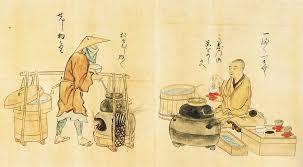
An historic image of the tea ceremony in Japan.


I think 2014 will be the year of the tea ceremony for me; I plan to partake in Vietnam, China, in Japan and with some persistence Seoul, South Korea and Pyongyang, North Korea.


Happy tea drinking! 


Cheerio.